SmurfTrsc for FlyBase
Smurf vs non-Smurf gene expression right on FlyBase pages. A browser extension for Chrome and Chromium-based browsers.
Reading a FlyBase page and wondering how the gene behaves as flies age? SmurfTrsc for FlyBase shows its expression in the whole-body transcriptome of Smurf and non-Smurf Drosophila melanogaster (Zane et al., 2023) directly on FlyBase report pages, so you can tell a change tied to the Smurf phase from a change with age without leaving the page you are reading.
What it shows
On FlyBase gene (FBgn), protein (FBpp), transcript (FBtr) and allele (FBal) pages, a panel at the top of the report gives, for the gene:
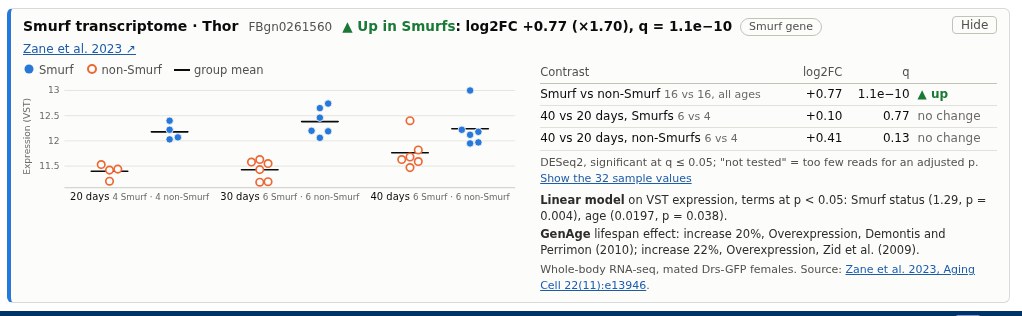
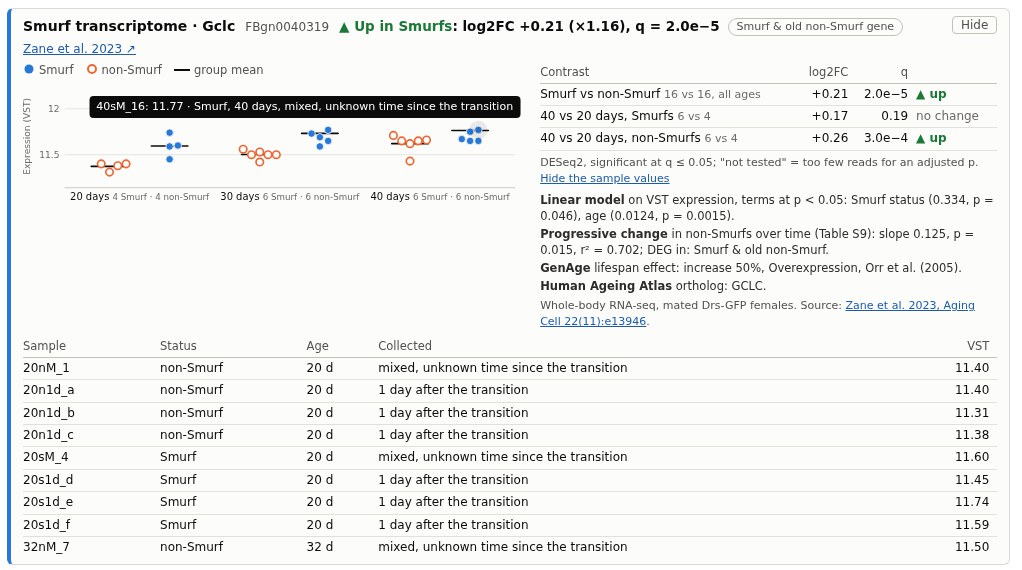
- A one-line verdict. Up, down or no change in Smurfs, with the log2 fold change and adjusted p, and the paper’s category: Smurf gene, old non-Smurf gene, or both.
- All 32 samples. A strip plot by age (20, 30 and 40 days) and Smurf status, with group means. Hover a sample for its details, or open the table of all values.
- Smurf status and age, side by side. The paper’s three DESeq2 contrasts: Smurfs vs non-Smurfs, and 40 vs 20 days within each status.
- The rest of the paper’s results for the gene, where it has them: longevity candidates, the linear model on expression, progressive change in non-Smurfs, proteomics, GenAge lifespan effects and the Human Ageing Atlas ortholog.
Where the data come from
The panel shows the published results of Zane et al. (2023): whole-body RNA-seq of mated Drs-GFP females, Smurf and non-Smurf, at 20, 30 and 40 days, analysed with DESeq2 (significant at adjusted p ≤ 0.05, as in the paper). Genes are matched to the current FlyBase release; genes renamed or merged since the paper’s annotation are flagged in the panel. The data come from the paper’s repository, SmurfsTrsc, and ship inside the extension.
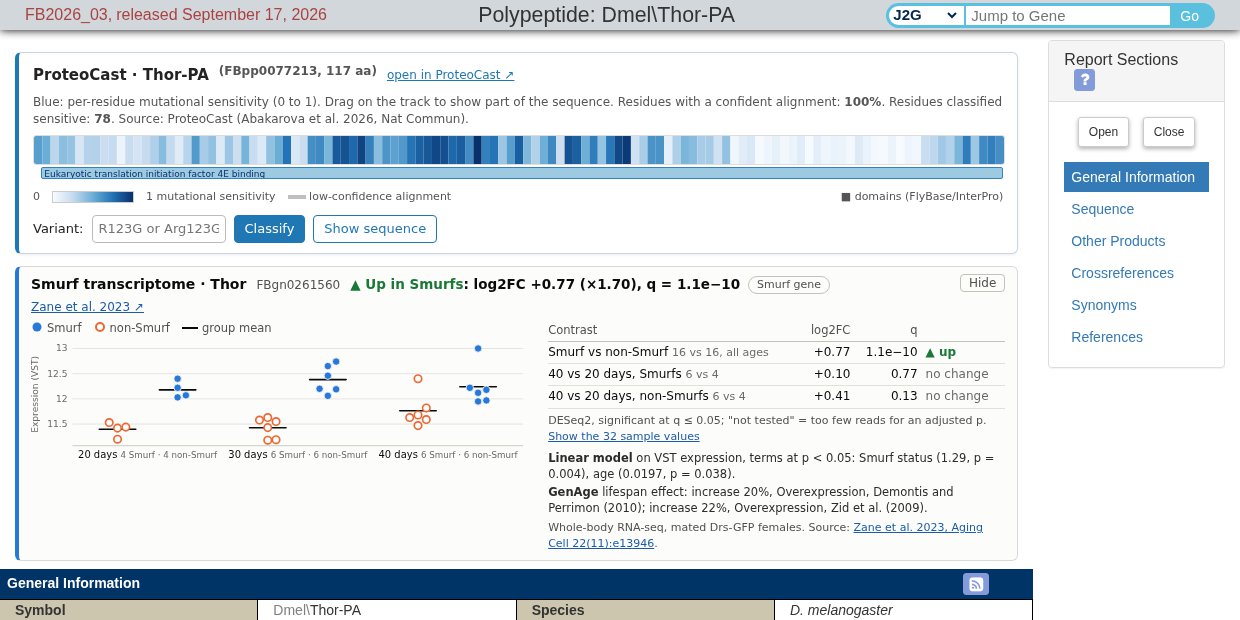
It works alongside ProteoCast for FlyBase: with both installed, the two panels sit one above the other.
Install
SmurfTrsc for FlyBase works in Chrome, Edge, Brave and other Chromium-based browsers.
- Chrome Web Store: coming soon.
- Source code: github.com/MichaelRera/smurftrsc-flybase (open source, GPL-3.0, coded with Claude Code; bug reports and suggestions welcome as GitHub issues).
Privacy
The extension reads only the FlyBase page you are on (the identifier in its address and, on allele pages, the associated gene). The data ship inside it: it makes no network requests at all. No analytics, no tracking, nothing collected.
How to cite
If these data help your work, please cite:
Zane F, Bouzid H, Sosa Marmol S, Brazane M, Besse S, Molina JL, Cansell C, Aprahamian F, Durand S, Ayache J, Antoniewski C, Todd N, Carré C, Rera M. Smurfness-based two-phase model of ageing helps deconvolve the ageing transcriptional signature. Aging Cell 22(11), e13946 (2023). doi:10.1111/acel.13946
SmurfTrsc for FlyBase is an independent tool and is not affiliated with FlyBase.