ProteoCast for FlyBase
Missense-variant predictions right on FlyBase pages. A browser extension for Chrome and Chromium-based browsers.
Reading a FlyBase page and wondering whether a mutation matters? ProteoCast for FlyBase adds the ProteoCast predictions of missense-variant effects to FlyBase report pages, so you can judge a Drosophila melanogaster amino-acid change without leaving the page you are reading.
What it shows
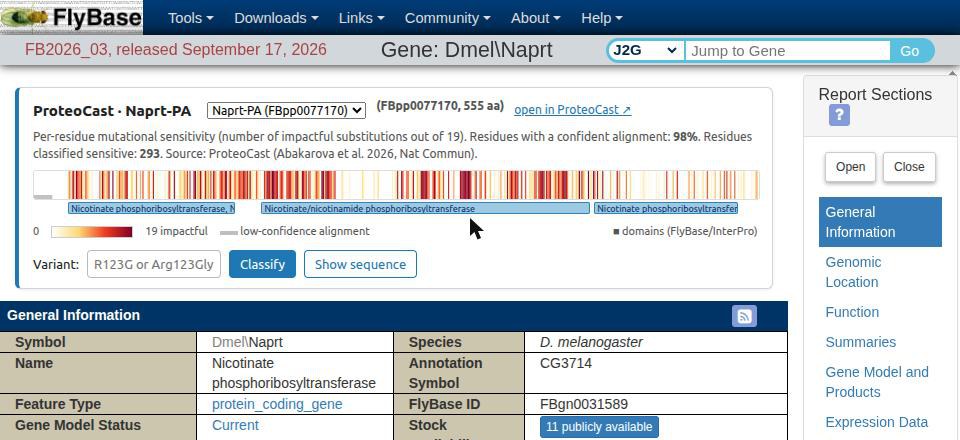
On FlyBase protein (FBpp), gene (FBgn) and allele (FBal) pages, a panel at the top of the report gives:
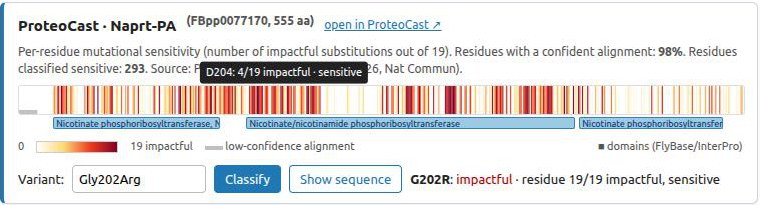
- Mutational sensitivity along the protein. Each residue is coloured by how many of its 19 possible substitutions ProteoCast predicts to be impactful, with the protein domains underneath and the positions where the evolutionary alignment is too thin to be confident shown in grey.
- A one-line variant classifier. Type
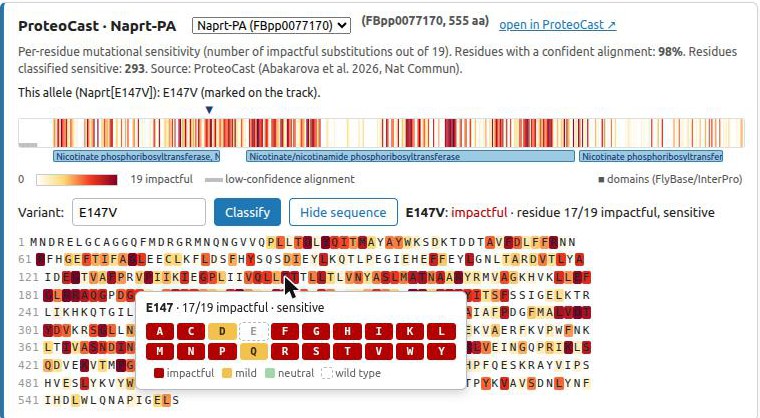
G202RorGly202Argand get impactful, mild or neutral, with a check that the reference residue matches the isoform you are looking at. - Every substitution at a glance. In the colour-coded sequence, hovering a residue shows its 19 substitutions coloured by predicted class.
- All isoforms of a gene, from a menu.
- The effect of an allele. On an allele page, the allele’s amino-acid replacement is classified and marked on the protein; alleles that are not missense changes get a short note.
Where the predictions come from
ProteoCast classifies every possible missense variant of a protein from its evolutionary history, built on the GEMME model, and identifies sensitive residues, including in disordered regions. The extension shows the proteome-wide predictions for D. melanogaster (FlyBase release 6.44 proteome), which cover about 99% of fly proteins; the panel says so when a protein has none. Predictions are served from the ProteoCast server at the Institut Jacques Monod; sequences, isoforms and domains come from FlyBase’s public API.
For a protein that is not in FlyBase, or for any other organism, use the ProteoCast web server directly.
Install
ProteoCast for FlyBase works in Chrome, Edge, Brave and other Chromium-based browsers.
- Chrome Web Store: coming soon.
- Test version: e-mail me and I will send it with installation instructions.
- Source code: github.com/MichaelRera/proteocast-flybase (open source, GPL-3.0; bug reports and suggestions welcome as GitHub issues).
Privacy
The extension reads only the FlyBase page you are on (the identifier in its address and, on allele pages, the amino-acid replacement). It asks FlyBase’s public API and the ProteoCast server for public data identified by that FlyBase ID, and nothing else. No analytics, no tracking, nothing collected.
How to cite
If ProteoCast predictions help your work, please cite:
Abakarova M, Freiberger MI, Liehrmann A, Rera M, Laine E. Proteome-wide prediction of the functional impact of missense variants with ProteoCast. Nature Communications 17, 3813 (2026). doi:10.1038/s41467-026-72140-1
and, for the web server:
Abakarova M, et al. ProteoCast: a web server to predict, validate, and interpret missense variant effects. Journal of Molecular Biology (2026). doi:10.1016/j.jmb.2026.169657
ProteoCast for FlyBase is an independent tool and is not affiliated with FlyBase.